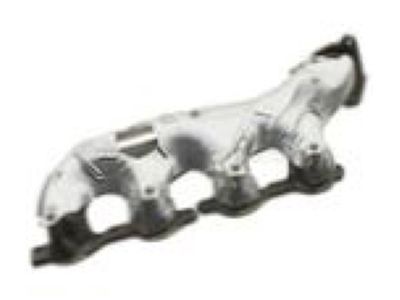
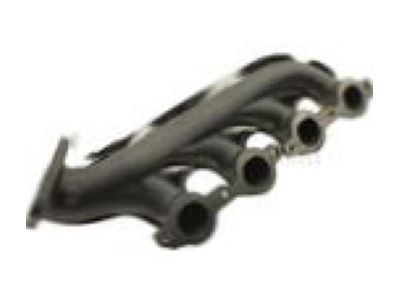
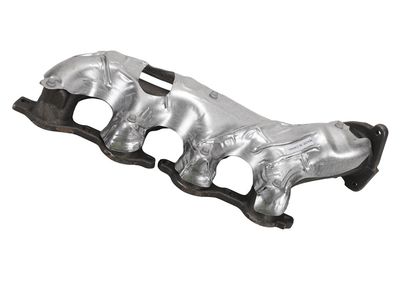
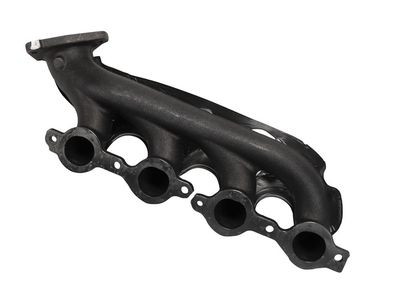
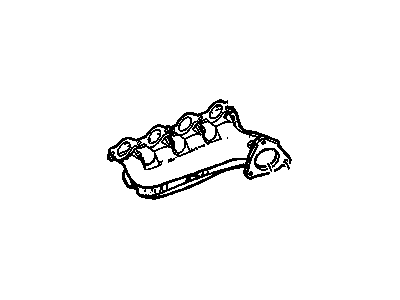
To remove the exhaust manifold, first disconnect the cable from the negative terminal of the battery and remove the engine cover. Raise the vehicle and support it securely on jackstands. Apply penetrating oil to the exhaust pipe-to-manifold studs and nuts, then remove the nuts retaining the exhaust pipe(s) to the manifold, accessing them from underneath the vehicle; on some models, it may be easier to remove the wheel and fender splash shield. For the right side manifold, remove the air filter housing, then the Secondary AIR bypass hoses and valves if equipped. Detach the spark plug wires and remove the plug wire retaining bracket, positioning the wires out of the way. Remove the oil dipstick and unbolt the dipstick tube bracket. On 2014 and earlier models, removing the inner splash shield from the fenderwell can provide easier access to the exhaust manifold. Bend the lock tabs back if equipped, then remove the mounting bolts and separate the exhaust manifold from the cylinder head, followed by removing the heat shields. For the left side manifold, remove the Secondary AIR injection pipe and the EGR pipe if equipped, then repeat the process of detaching the spark plug wires and removing the plug wire retaining bracket. Disconnect the electrical connector from the Engine Coolant Temperature sensor, bend the lock tabs back if equipped, and remove the mounting bolts to separate the exhaust manifold from the cylinder head, also removing the heat shields. For installation, check the manifold for cracks and ensure the bolt threads are clean and undamaged, making sure the mating surfaces are clean before reinstalling. Position the manifold on a bench to install the heat shields, bolts, and gaskets, then place the manifold on the cylinder head and install the mounting bolts finger tight. When tightening the mounting bolts, work from the center to the ends using a torque wrench, tightening in two steps. If equipped, bend the locking tabs back against the bolt heads. The remaining installation steps follow the reverse order of removal, and finally, start the engine to check for exhaust leaks.