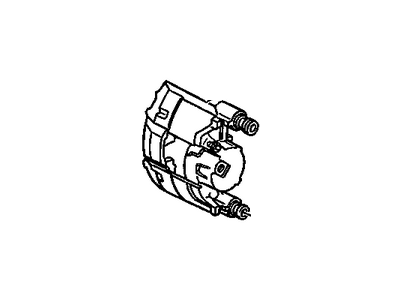
The pads of disc brakes on a car should be changed in pairs; it is unadvisable to change the pad on just one wheel. To start with, unlock the brake caliper from the rotor and use a C-clamp to condition the piston into the caliper in order to first create enough room for the new brake pads. You have to use the water pump pliers to grab and take off the retaining clip on the backside of the outboard pad. The inboard pad, held by the piston via four small tangs on circular spring clip, comes off by hand. Couples of things to be careful of are the position of the two pins of the backing plate relative to the deep round cutouts of the piston face since these pins arrest the rotation of the piston through the actuator screw when parking have is on. Finally, take out the bolt boots, bushings and sleeves threaded through the Caliper Mounting Bolts, bottom the Piston on the Cylinder Bore and fit new pads. Sometimes there is leakage around the piston/caliper interface; in this case the caliper must be overhauled. Silicone grease should be applied on the new bushings, bolt boots and sleeves then they should be fixed in their respective positions. Insert the inboard pad assembly into the caliper in a manner that the O formed tab fits into the O formed notch in the piston of the caliper while further realigning the piston of the caliper. If properly aligned, the inboard pad assembly with the wear sensor will be at the leading edge of the backing plate laid smooth against the piston. Third, you should fit the outboard pad assembly into the caliper firmly. Place the caliper back over the rotor and torque the bolts to the factory set standard torque value. Position the linings by depressing the brake pedal with sufficient force and subsequent jiggling of at least three times and fix the parking brake lever into the actuator screw hex. Last, ensure the working of the brakes and then move the car into traffic or road with interest.