
My Garage
My Account
Cart
Genuine 1985 Pontiac Firebird Cylinder Head
Head- Select Vehicle by Model
- Select Vehicle by VIN
Select Vehicle by Model
orMake
Model
Year
Select Vehicle by VIN
For the most accurate results, select vehicle by your VIN (Vehicle Identification Number).
2 Cylinder Heads found
 Product Specifications
- Other Name: Head Kit,Cyl; Cylinder Head
- Item Weight: 46.90 Pounds
- Item Dimensions: 22.4 x 8.7 x 4.8 inches
- Condition: New
- Fitment Type: Direct Replacement
- SKU: 12360335
- Warranty: This genuine part is guaranteed by GM's factory warranty.
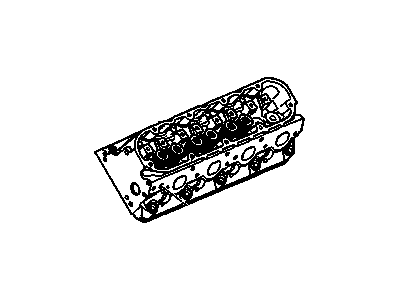 Product Specifications
- Other Name: Head, Cyl
- Item Weight: 29.60 Pounds
- Item Dimensions: 21.2 x 6.6 x 6.7 inches
- Condition: New
- Fitment Type: Direct Replacement
- Require Quantity: 2
- SKU: 14054884
- Warranty: This genuine part is guaranteed by GM's factory warranty.
1985 Pontiac Firebird Cylinder Head
We are your prime source for competitively priced and high-quality OEM 1985 Pontiac Firebird Cylinder Head. We provide you with parts that will allow you to save a lot of money without sacrificing quality. All our OEM parts are backed by the manufacturer's warranty and shipped out at a swift rate.
1985 Pontiac Firebird Cylinder Head Parts Questions & Experts Answers
- Q:How should the Cylinder Head be prepared for reassembly after valve servicing on 1985 Pontiac Firebird?Posted by Bon L.A:Regardless of whether the head was sent to an automotive machine shop for valve servicing, ensure it is clean before beginning reassembly. If the head was sent out for valve servicing, the valves and related components will already be in place, so start the reassembly procedure accordingly. Lay all the spring seats in position, then lubricate and install new seals or deflectors on each of the valve guides for V6 intake valves and all VS valves. Using a hammer and an appropriately sized deep socket, gently tap each seal into place until it is properly seated on the guide, avoiding any twisting or cocking during installation to ensure a proper seal on the valve stems. Coat the valve stems with clean moly-based grease or engine assembly lube and install the valves, taking care not to damage the new valve guide seals. Install the springs, shields if equipped, and retainers or rotators, ensuring that if the valve springs are wound closer at one end, they are installed correctly. Compress the spring and install the O-ring seals in the lower valve stem groove, ensuring they are not twisted, with a light coat of oil to prevent twisting. When compressing the springs with the valve spring compressor, avoid letting the retainers contact the valve guide seals. Install the keepers and release the spring compressor, ensuring the keepers are securely locked in their retaining grooves by tapping on the spring retainer with a soft-faced hammer. Double-check the installed valve spring height; if it was correct before disassembly, it should still be within the specified limits. Check the valve stem O-ring seals with a vacuum pump and adapter to ensure a properly installed seal does not leak. When installing the rocker arms, lubricate the ball pivots with moly-based grease or engine assembly lube.Answered by GM Parts Specialist Jose / Apr 21, 2023
Related 1985 Pontiac Firebird Parts
 1985 Pontiac Firebird Rocker Arm
 1985 Pontiac Firebird Rocker Shaft Spring Kit
 1985 Pontiac Firebird Camshaft
 1985 Pontiac Firebird Timing Cover
 1985 Pontiac Firebird Intake Valve
 1985 Pontiac Firebird Exhaust Valve