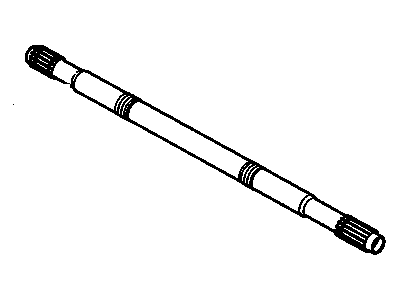
Two driveaxles transfer power from the transaxle to the wheels, through the side gears of the differential if the latter's inner ends are splined, or an intermediate axleshaft if the splined parts are the outer ends of the driveaxles; the outer ends of the axles are splined to the axle hubs and locked by a large nut. The inner ends have CV joints with a slide that provides an angular as well as axial movement; some of the assemblies consist of tripot bearing and a joint housing that permits sliding when the driveaxle moves along the wheel, the others are ball-and-cage type where there are six balls between the inner and outer races separated by a cage. These inner joints can only be serviced-disassembled, cleaned and repacked; it cannot be overhauled, and when some of the parts are damaged, the entire unit needs to be replaced. Self-supporting outer CV joints, cross-groove or ball-and-cage design, enable angular motion but no axial movement and like the inner joint both are designed for dismantling and cleaning with worn components: being replaced by new complete units. One has to check the boots' condition often as finding a damaged CV joint boot should prompt an immediate replacement to avoid the joint's deterioration. Boot replacement in most cases requires the driveaxle to be removed but some auto part stores stocks split-type replacement boots that can be installed without the driveaxle being removed. Still, aspiring to clean up the driveaxle and reveal for cleaning the CV joint that those contaminants will quicken put on and tear the unit, it is preferable to take out the driveaxle and disassemble the CV joint in part. Some of the signs that a CV joint has become worn or damaged include grease leakage and squeaking sound on operation. On each axle, the CV joint housings should be held and the axle rotated in both of the directions and any play in the splines or loose joints indicating wear in the CV joints and the driveaxle shafts should be checked for cracks, dents and distortion.